
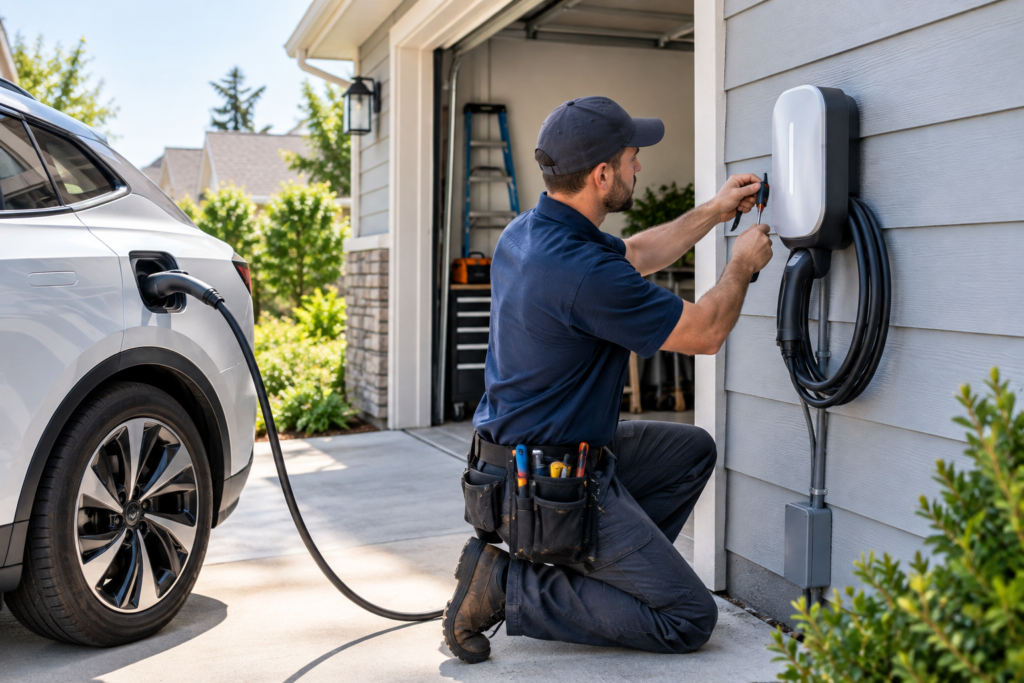
More homeowners are making the switch to electric vehicles, and one of the first questions that comes up is simple: can my home actually support a home charging setup? The answer is usually yes, but getting it done safely and correctly involves more than just plugging in a charger. Here’s what to know before you install one.
Level 1 vs. Level 2 Charging
Not all home EV charging is the same:
- Level 1 charging uses a standard 120V outlet – the same one your appliances use. It works, but charging is slow, often adding only 3-5 miles of range per hour.
- Level 2 charging uses a 240V circuit, similar to what powers a dryer or oven, and can add 20-30+ miles of range per hour. This is what most homeowners actually want for daily convenience.
If you’re relying on your EV for daily driving, Level 2 charging is almost always the better long-term choice – but it requires a dedicated circuit installed by a licensed electrician.
Why This Isn’t a DIY Project
EV chargers draw significant continuous power, which means the installation needs to account for:
- Panel capacity – Your electrical panel needs enough available capacity to handle the additional load without overloading the system
- Dedicated circuit requirements – Most Level 2 chargers need their own 240V circuit, sized correctly for the charger’s amperage
- Proper wiring gauge – Undersized wiring on a high-draw circuit is a real fire risk, not just an inconvenience
- Permit and code compliance – Many municipalities require permits and inspections for EV charger installations
A licensed EV charger installation service handles all of this correctly the first time, rather than leaving you with a setup that trips breakers or, worse, creates a safety hazard.
Does Your Panel Need an Upgrade?
This is one of the most common surprises homeowners run into. Older homes, especially those with 100-amp panels, may not have enough spare capacity to add a Level 2 charger alongside existing appliances and HVAC loads. In these cases, an electrical panel upgrade is often necessary before charger installation can move forward safely. A proper load calculation during your initial consultation will tell you whether this applies to your home.
Where Should the Charger Go?
Placement affects both cost and convenience:
- Garage installations are typically the simplest, since panels are often nearby
- Driveway or exterior installations may require additional conduit and weatherproof equipment
- Distance from the panel directly impacts wiring cost – the farther the charger is from your electrical panel, the more wiring (and labor) is involved
Discussing placement early, before installation day, helps avoid surprises in the final quote.
Smart Charging and Home Integration
Many newer EV chargers offer smart features – scheduling charging during off-peak electricity hours, monitoring usage, or integrating with home energy systems. If you’re interested in this route, it’s worth pairing your charger installation with a broader look at smart home wiring, since these systems often work best when planned together rather than added piecemeal.
What to Expect From Installation Day
A typical installation involves:
- Load calculation – Confirming your panel can safely support the added circuit
- Circuit installation – Running a dedicated 240V line from your panel to the charger location
- Charger mounting and wiring – Installing and connecting the charging unit itself
- Testing – Verifying proper function and safe operation
- Inspection – Where required, scheduling the necessary code inspection
Most straightforward installations are completed in a single day, though panel upgrades or longer wiring runs can extend the timeline.
A Note for Homeowners Outside Our Service Area
Electrical work – especially anything involving dedicated circuits, panel capacity, or code compliance – should always be handled by a licensed electrician familiar with your local requirements. If you’re outside our service area, A One Electric Work is another licensed team that handles similar residential electrical projects, including EV charger and panel work.
EV charger installation looks simple from the outside, but panel capacity, wiring requirements, and code compliance all matter more than people expect. Getting a proper load calculation and professional installation upfront means your charger works reliably from day one – and safely for years to come.
Leave a Reply